
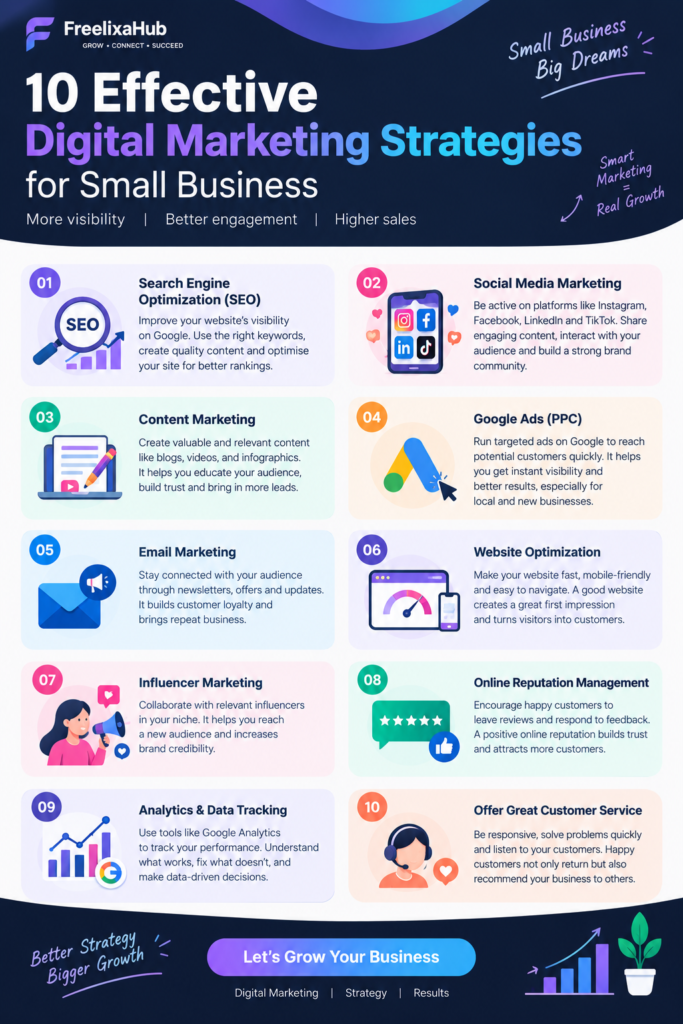
10 Effective Digital Marketing Strategies for Small Business in 2026
Primary Keyword: 10 Effective Digital Marketing Strategies for Small Business
Secondary Keywords: Digital marketing strategies for small businesses, small business digital marketing, online marketing for small businesses, digital marketing tips for startups
Suggested Blog URL: /10-effective-digital-marketing-strategies-for-small-business/
Introduction
In 2026, digital marketing has become an important part of business growth. Whether you own a small shop, an online store, a startup, or a service-based business, having a strong online presence can help you attract new customers and build your brand. Today, people use search engines, social media platforms, websites, and online reviews to discover products and services. This makes digital marketing an excellent opportunity for small businesses to connect with their target audience.
However, many small business owners believe that digital marketing requires a large budget or advanced technical knowledge. In reality, businesses can begin with simple and affordable strategies. By understanding their audience, creating valuable content, and using the right digital tools, small businesses can improve their visibility and compete with larger brands.
Digital marketing is not only about selling products. It is also about building relationships, creating trust, solving customer problems, and delivering value.
In this blog, we will discuss 10 effective digital marketing strategies for small business that can help you increase website traffic, attract potential customers, improve brand awareness, and support long-term business growth.
What Is Digital Marketing for Small Businesses?
Digital marketing is the process of promoting products, services, or brands through online channels. These channels include search engines, websites, social media, email, online advertisements, and other digital platforms.
For small businesses, digital marketing provides an opportunity to reach customers beyond their local area. A business can promote its services to people in a particular city, state, country, or even internationally, depending on its goals and resources.
For example, a small graphic design agency can use SEO to attract website visitors, Instagram to showcase its designs, and email marketing to communicate with potential clients.
Some important digital marketing channels include:
- Search Engine Optimization (SEO)
- Social Media Marketing
- Content Marketing
- Google Ads and PPC
- Email Marketing
- Website Marketing
- Influencer Marketing
- Online Reputation Management
- Analytics and Data Tracking
The best approach depends on your business type, target audience, budget, and marketing objectives.
10 Effective Digital Marketing Strategies for Small Business
1. Search Engine Optimization (SEO)
Search Engine Optimization, commonly known as SEO, is one of the most valuable strategies for small business digital marketing. SEO helps improve the visibility of your website in search engine results.
When potential customers search for products or services related to your business, you want your website to be easy to find. A well-optimized website can attract relevant visitors through unpaid or organic search results.
For example, imagine you run a small digital marketing agency. A potential customer searches for “digital marketing agency for small businesses.” If your website contains useful information related to that topic and follows good SEO practices, it may have an opportunity to appear in relevant search results.
How to improve your website SEO
Keyword research: Identify the words and phrases your target audience uses when searching for your products or services.
Create useful content: Publish informative blog posts, service pages, tutorials, and guides that answer customer questions.
Optimize page titles and headings: Use clear titles and headings that describe the content of each page.
Improve website speed: A fast website provides a better user experience.
Make your website mobile-friendly: Many people browse the internet using smartphones, so your website should work well on different screen sizes.
Build relevant links: Use internal links to connect related pages and earn trustworthy external links when appropriate.
SEO is not an instant solution. It requires consistent effort, useful content, and regular improvements. However, it can become a valuable long-term source of website traffic.
2. Social Media Marketing
Social media marketing is another powerful strategy for small businesses. Platforms such as Instagram, Facebook, LinkedIn, YouTube, and TikTok allow businesses to communicate with their target audience and promote their products or services.
Social media can be especially useful for businesses that depend on visual content, community engagement, or personal relationships.
For example, a small clothing brand can share product photos, styling tips, customer reviews, and short videos. A digital marketing agency can publish SEO tips, marketing tutorials, client success stories, and behind-the-scenes content.
Effective social media marketing techniques
- Create a professional business profile.
- Share content consistently.
- Use attractive images and videos.
- Publish educational and entertaining posts.
- Respond to comments and messages.
- Use relevant hashtags where appropriate.
- Share customer testimonials.
- Experiment with short-form videos.
- Study which content receives the most engagement.
It is not necessary to use every social media platform. Instead, choose the platforms where your target audience is most active.
For example, LinkedIn may be useful for professional services and B2B marketing, while Instagram may be effective for fashion, beauty, design, and lifestyle businesses.
The goal of social media marketing is to build meaningful connections rather than simply collect followers.
3. Content Marketing
Content marketing involves creating and sharing valuable information to attract and educate a specific audience. It is one of the most useful digital marketing strategies for businesses that want to build trust over time.
Instead of promoting your products in every post, you can create content that helps people solve problems or understand a topic.
For example, a digital marketing agency can publish articles such as:
- How to Improve Your Website Traffic
- Beginner’s Guide to SEO
- Social Media Marketing Tips for Startups
- How to Create a Digital Marketing Plan
- Benefits of AI in Digital Marketing
This type of content can attract people who are interested in your services and may eventually become customers.
Types of content marketing
Blog posts: Share detailed information, guides, and solutions to common problems.
Videos: Explain concepts, demonstrate products, or provide tutorials.
Infographics: Present information in a simple and visual format.
Case studies: Show how your product or service helped solve a real customer problem.
E-books: Provide detailed information about a specific subject.
Social media content: Share quick tips, educational posts, and engaging visuals.
Why content marketing is important
Content marketing can help your business:
- Build brand awareness.
- Improve website visibility.
- Educate potential customers.
- Establish industry credibility.
- Support SEO efforts.
- Generate leads over time.
The most successful content is useful, original, relevant, and created for a clearly defined audience.
4. Google Ads and Pay-Per-Click Advertising
Google Ads is a paid advertising platform that allows businesses to promote their products and services through advertisements on Google and its advertising network.
Pay-Per-Click advertising, or PPC, is a model in which advertisers generally pay when someone clicks on their advertisement. Google Ads can help businesses reach people who are actively searching for particular products or services.
For example, a small website design agency could create an advertising campaign targeting phrases such as:
- Affordable website design services
- Website designer for small businesses
- Digital marketing agency services
- Professional logo design
When people search for relevant terms, advertisements may appear depending on the campaign settings, competition, budget, and other factors.
Tips for successful Google Ads campaigns
Choose relevant keywords: Select search terms that match the services you offer.
Set a clear budget: Decide how much you can afford to spend on advertising.
Write attractive ad copy: Explain your services clearly and include a strong call to action.
Create useful landing pages: Send visitors to pages that match the advertisement.
Target the right audience: Consider location, language, and other relevant campaign settings.
Track conversions: Measure actions such as inquiries, purchases, or form submissions.
PPC can provide quicker visibility than many organic marketing methods, but it requires careful planning. Spending money on advertisements does not automatically guarantee sales.
5. Email Marketing
Email marketing is a direct communication method that allows businesses to connect with customers and subscribers. It can be used to share information, promote products, provide updates, and build long-term relationships.
For small businesses, email marketing can be a cost-effective way to stay connected with people who have shown interest in their brand.
For example, an online clothing store can send emails about new collections, seasonal offers, and useful styling tips. A digital marketing agency can send newsletters containing SEO advice, marketing trends, and information about its services.
Common types of email marketing
- Welcome emails
- Promotional emails
- Monthly newsletters
- Product announcements
- Educational emails
- Customer feedback emails
- Special event invitations
How to create an effective email marketing campaign
First, collect email addresses through ethical methods, such as website signup forms or customer subscriptions. Then, divide your audience into relevant groups based on their interests or previous interactions.
Create useful and engaging email content. Use clear subject lines, simple designs, and strong calls to action.
You should also monitor important metrics such as open rates, click-through rates, and conversions.
Always respect privacy requirements and provide an easy way for recipients to unsubscribe.
6. Build a Professional and Mobile-Friendly Website
A website is the online identity of your business. It provides important information about your products, services, company, and contact details.
For many customers, your website is their first interaction with your brand. A professional website can help establish credibility and make it easier for visitors to take action.
A website is especially important for small businesses because it allows customers to learn about your business at any time.
Important features of a business website
Clear navigation: Visitors should be able to find information easily.
Mobile-friendly design: The website should work properly on smartphones and tablets.
Fast loading speed: Pages should load efficiently.
Professional appearance: Use consistent fonts, images, colors, and branding.
Clear service descriptions: Explain what you offer and how it helps customers.
Strong calls to action: Include buttons such as “Contact Us,” “Get a Quote,” or “Book a Consultation.”
Contact information: Make it easy for customers to reach your business.
Trust-building content: Add testimonials, case studies, and relevant business information.
For example, a digital marketing agency website can include Home, About Us, Services, Blog, Portfolio, Contact, and Privacy Policy pages.
A website should not only look attractive. It should also provide a smooth experience and help visitors complete their goals.
7. Influencer and Partnership Marketing
Influencer marketing involves collaborating with content creators who have an audience interested in a particular topic or industry.
Small businesses can work with relevant creators to promote their products or services. You do not always need to collaborate with celebrities. Micro-influencers with smaller but engaged audiences may be suitable for specific campaigns.
For example, a small skincare brand might collaborate with a beauty content creator to demonstrate a product. A local restaurant could work with a food blogger to introduce its menu to a relevant audience.
How to use influencer marketing effectively
- Identify influencers in your business niche.
- Study their audience and engagement.
- Check whether their content matches your brand.
- Set clear campaign objectives.
- Discuss deliverables and compensation.
- Track website visits, inquiries, or sales.
- Evaluate the results of the collaboration.
Partnership marketing can also include collaborations with complementary businesses.
For example, a graphic designer may partner with a website developer, while a fitness trainer may collaborate with a nutrition-related business.
The most important factor is relevance. A partnership should connect your business with people who may genuinely benefit from your products or services.
8. Online Reputation Management
Online reputation management is the process of monitoring and improving how people perceive your business online.
Before purchasing a product or service, many customers check reviews, ratings, testimonials, and social media feedback. A positive online reputation can help build confidence in your business.
For local businesses, a Google Business Profile can be useful for sharing business information, displaying customer reviews, and helping eligible businesses appear in local search and Maps results.
For example, a small salon can use its online presence to display its services, opening hours, location, and genuine customer reviews.
Ways to manage your online reputation
Encourage genuine reviews: Ask satisfied customers to share honest feedback.
Respond to reviews: Thank customers for positive feedback and address complaints professionally.
Keep business information accurate: Update your contact details, services, and operating hours.
Monitor online mentions: Pay attention to what people say about your brand.
Resolve customer problems: Try to solve complaints quickly and respectfully.
Share customer experiences: With permission, publish authentic testimonials and success stories.
Never create fake reviews or mislead customers. Trust is an important part of long-term business success.
A good online reputation can encourage customers to choose your business over competitors.
9. Analytics and Data Tracking
One of the biggest advantages of digital marketing is the ability to measure performance. Analytics tools help businesses understand how people interact with their websites, advertisements, and content.
Without tracking, it can be difficult to know which marketing activities are producing useful results.
For example, suppose you publish five blog posts on your website. Analytics and search performance data may help you understand which posts attract visitors, which pages receive engagement, and where improvements may be needed.
Important digital marketing metrics
| Metric | Meaning |
|---|---|
| Website Traffic | Number of visitors coming to your website |
| Conversion Rate | Percentage of visitors who complete a desired action |
| Click-Through Rate | Percentage of people who click a link or advertisement |
| Engagement Rate | How people interact with your content |
| Cost per Lead | Amount spent to generate a potential customer |
| Return on Investment | Value generated compared with marketing costs |
| Search Impressions | How often your pages appear in search results |
Useful analytics tools
- Google Analytics
- Google Search Console
- Social media analytics
- Advertising platform reports
- Email marketing analytics tools
Small businesses should focus on metrics that match their goals.
If your goal is to generate leads, track inquiries and form submissions. If your goal is to increase brand awareness, monitor reach, impressions, and engagement.
Data helps you make better marketing decisions instead of relying only on assumptions.
10. Provide Excellent Digital Customer Service
Customer service is an important part of digital marketing because customers want quick, helpful, and reliable communication.
A business may attract visitors through SEO, social media, or advertising, but poor customer service can prevent those visitors from becoming paying customers.
Today, customers may contact businesses through websites, email, social media, live chat, or messaging applications.
For example, if someone visits a digital marketing agency website and asks about SEO services, responding clearly and professionally can improve the customer experience.
Ways to improve digital customer service
- Respond to customer messages promptly.
- Provide accurate product and service information.
- Make contact details easy to find.
- Answer frequently asked questions.
- Resolve complaints professionally.
- Offer clear pricing or quotation information where appropriate.
- Follow up after a purchase or service.
- Collect customer feedback.
- Use helpful automated responses when suitable.
Excellent customer service can improve customer satisfaction and encourage repeat business.
Happy customers may also recommend your brand to friends, family, or colleagues. This can support word-of-mouth marketing and help your business grow.
How to Create a Digital Marketing Plan for Your Small Business
Using the 10 effective digital marketing strategies for small business can be helpful, but it is important to create a plan before starting.
A digital marketing plan gives your business direction and helps you use your time and budget wisely.
Step 1: Identify Your Target Audience
Understand who your ideal customers are. Consider their age group, interests, location, needs, and buying behavior.
For example, a local bakery may target nearby residents, while an online design agency may serve customers across different cities or countries.
Step 2: Set Clear Marketing Goals
Decide what you want to achieve through digital marketing.
Your goals may include:
- Increasing website traffic.
- Generating more leads.
- Improving brand awareness.
- Increasing online sales.
- Growing social media engagement.
- Building customer loyalty.
Your goals should be specific and measurable whenever possible.
Step 3: Choose the Right Marketing Channels
You do not need to use every digital platform. Select the channels that are most suitable for your audience and business.
For example:
- SEO for long-term search visibility.
- Instagram for visual content.
- LinkedIn for professional networking.
- Email marketing for customer communication.
- Google Ads for targeted paid traffic.
Step 4: Create a Content Calendar
A content calendar helps you plan and organize your marketing activities.
You can schedule blog posts, social media content, videos, newsletters, and promotional campaigns.
Consistency is more important than publishing a large amount of content at once.
Step 5: Set a Realistic Budget
Decide how much money you can invest in digital marketing.
Your budget may cover:
- Website development.
- Advertising.
- Marketing tools.
- Content creation.
- Graphic design.
- SEO services.
- Email marketing software.
Start with a manageable budget and increase spending only when your results justify it.
Step 6: Track and Improve Your Results
Review your performance regularly. Identify what is working and what needs improvement.
If a particular blog post attracts visitors, consider creating related content. If an advertisement does not produce useful results, review its audience, message, or landing page.
Digital marketing is an ongoing process of testing, learning, and improving.
Common Digital Marketing Mistakes Small Businesses Should Avoid
While digital marketing can provide many opportunities, some common mistakes can reduce its effectiveness.
1. Trying to Use Every Platform
Managing too many platforms can become difficult. Focus on the channels that are relevant to your audience.
2. Ignoring SEO
A beautiful website may struggle to attract visitors if its content and technical performance are not optimized.
3. Posting Without a Strategy
Random content may not support your business goals. Plan content around your audience and objectives.
4. Focusing Only on Selling
Customers also want useful information, solutions, and meaningful communication.
5. Ignoring Customer Feedback
Feedback can help you understand what customers like and where your business needs improvement.
6. Not Measuring Results
Without analytics, it is difficult to identify successful campaigns or make informed decisions.
7. Expecting Instant Success
SEO, content marketing, and brand building often require time and consistent effort. Paid advertising may generate quicker visibility, but results still depend on campaign quality and market conditions.
Benefits of Digital Marketing for Small Businesses
Digital marketing can provide several benefits when used strategically.
1. Wider Audience Reach
Online platforms allow businesses to reach potential customers beyond their immediate location.
2. Cost Flexibility
Businesses can choose from free, organic methods and paid strategies according to their budgets.
3. Better Customer Communication
Social media, email, and websites make it easier to communicate with customers.
4. Improved Brand Awareness
Consistent digital content can help people recognize and remember your business.
5. Measurable Results
Analytics tools allow businesses to track performance and make improvements.
6. Increased Customer Trust
Useful content, genuine reviews, and professional communication can help establish credibility.
7. Long-Term Growth Opportunities
A strong online presence can support customer relationships, lead generation, and business expansion.
Future of Digital Marketing for Small Businesses in 2026
Digital marketing continues to evolve as technology and customer behavior change. In 2026, small businesses can explore new tools and techniques to improve their marketing efforts.
Artificial intelligence is becoming increasingly useful for tasks such as content planning, customer support, data analysis, and marketing automation. Businesses can use AI tools to save time and generate ideas, but human creativity, fact-checking, and strategic decision-making remain important.
Short-form video content is also an important format for many brands. Businesses can use videos to explain products, share tutorials, and connect with audiences.
Personalization is another useful area. Customers appreciate content and offers that are relevant to their interests and needs.
Voice search, mobile-friendly websites, local SEO, and data-driven marketing may also provide opportunities for businesses to improve their online presence.
However, businesses should avoid following every trend without considering its value. The best approach is to test new methods and focus on strategies that provide meaningful results.
Frequently Asked Questions
1. What are the 10 effective digital marketing strategies for small business?
The 10 strategies are SEO, social media marketing, content marketing, Google Ads, email marketing, website optimization, influencer marketing, online reputation management, analytics and data tracking, and excellent digital customer service.
2. Which digital marketing strategy is best for a small business?
The best strategy depends on your business goals and target audience. SEO, social media marketing, and content marketing are useful starting points for many small businesses.
3. How much does digital marketing cost for a small business?
The cost depends on your marketing channels, goals, tools, and advertising budget. Businesses can begin with organic strategies and gradually invest in paid marketing.
4. How long does digital marketing take to show results?
The time varies by strategy. Paid advertising may provide quicker visibility, while SEO, content marketing, and brand building often require consistent effort over a longer period.
5. Can a small business do digital marketing without an agency?
Yes. Small businesses can manage basic SEO, social media, content creation, and email marketing themselves. An agency may be helpful when specialized skills or additional resources are needed.
6. Why is digital marketing important in 2026?
Digital marketing helps businesses connect with customers online, promote products and services, build brand awareness, and measure marketing performance.
Conclusion
The 10 effective digital marketing strategies for small business discussed in this blog can help entrepreneurs develop a strong online presence and support business growth in 2026. From SEO and social media marketing to content creation, email marketing, Google Ads, and customer service, each strategy has an important role in reaching and engaging potential customers.
Small businesses do not need to use every strategy immediately. The best approach is to understand your target audience, choose the right marketing channels, set clear goals, and create a practical plan.
Consistency, creativity, customer trust, and data-driven decisions are essential for long-term success. By regularly reviewing your results and improving your strategy, you can build a stronger brand and create new opportunities for growth.
Start small, focus on your customers, and use digital marketing to turn your business goals into meaningful results.