
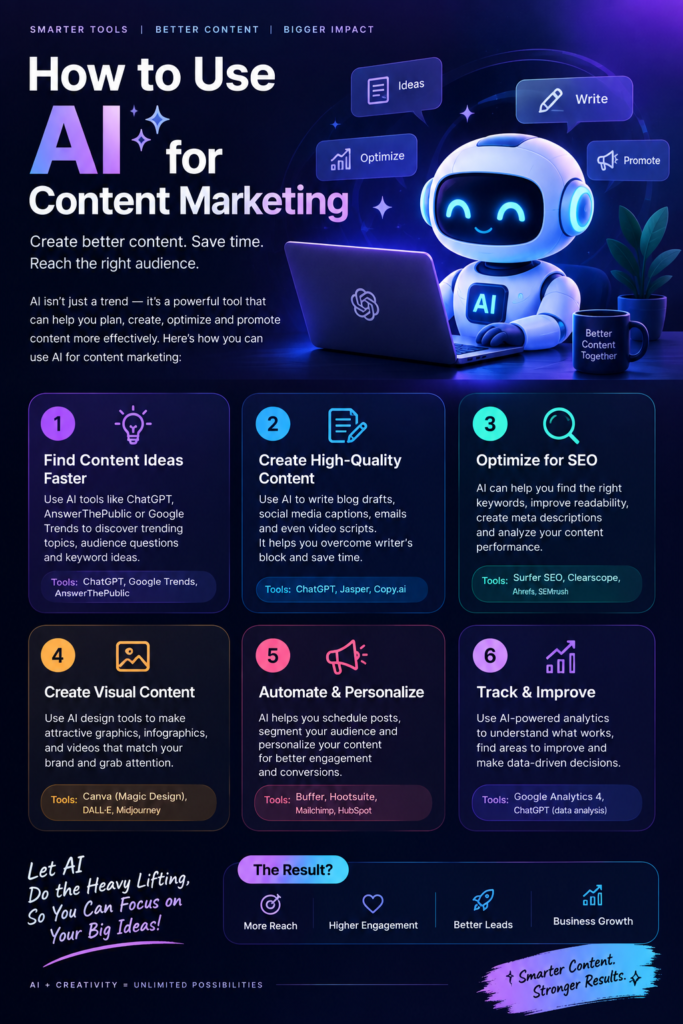
How to Use AI for Content Marketing: A Complete Guide for 2026
Primary Keyword: How to Use AI for Content Marketing
Related Keywords: AI content marketing, AI tools for content marketing, AI content creation, content marketing strategy, AI for SEO, AI marketing tools, content marketing with AI, artificial intelligence in marketing
Introduction
Content marketing has become one of the most important ways for businesses to attract customers, build trust, and grow their online presence. However, creating high-quality content consistently can take a lot of time and effort. This is where artificial intelligence, or AI, can make a significant difference.
If you are wondering how to use AI for content marketing, AI can help with almost every stage of the content process—from finding ideas and researching topics to writing, SEO optimization, visual creation, promotion, and performance analysis.
AI does not have to replace human creativity. Instead, it can work as a smart assistant that helps marketers save time, understand their audience, and create more useful content.
In this guide, we will explore practical ways to use AI for content marketing and how businesses can combine AI technology with human creativity to build a stronger content marketing strategy.
What Is AI Content Marketing?
AI content marketing means using artificial intelligence tools and technologies to support the process of planning, creating, optimizing, distributing, and analyzing marketing content.
Traditional content marketing requires marketers to manually research topics, create outlines, write articles, design graphics, optimize content for search engines, and analyze results.
AI can assist with many of these tasks.
For example, AI can help you:
- Find content ideas
- Research customer questions
- Create blog outlines
- Write first drafts
- Improve headlines
- Generate social media captions
- Suggest keywords
- Optimize content for SEO
- Create content variations
- Analyze marketing data
- Personalize content for different audiences
The key is to use AI as a supporting tool, while humans remain responsible for strategy, originality, accuracy, brand voice, and final decisions.
1. Use AI to Find Content Ideas
One of the first steps in content marketing is finding topics your audience actually wants to read about.
Coming up with new ideas every week can be difficult. AI can help marketers generate topic ideas based on their target audience, industry, products, and marketing goals.
For example, if you run a digital marketing agency, you can ask an AI tool to generate topics around:
- SEO
- Social media marketing
- Content marketing
- Email marketing
- Google Ads
- AI marketing
- Small business marketing
- Website traffic
- Digital marketing trends
You can also ask AI to organize ideas into beginner, intermediate, and advanced topics.
Example AI prompt:
“Give me 20 blog topics about digital marketing for small businesses. Focus on topics that solve common problems and have strong search potential.”
AI can give you a starting list, which you can then research and refine using keyword research and audience data.
2. Use AI for Audience Research
Successful content starts with understanding your audience.
Before creating content, you need to know:
- What problems does your audience have?
- What questions are they asking?
- What information are they searching for?
- What products or services do they need?
- What motivates them to take action?
AI can help organize customer feedback, reviews, surveys, comments, and other information into common themes.
For example, a small business audience may have questions such as:
“How can I get more customers from Instagram?”
“How can I increase my website traffic?”
“How much does digital marketing cost?”
These questions can become useful blog topics, social media posts, videos, or email campaigns.
This makes your content marketing strategy more audience-focused instead of simply creating content without a clear purpose.
3. Use AI to Create Blog Outlines
Writing a complete article can feel overwhelming, especially when you don’t know how to organize the information.
AI can help you create a logical blog structure.
For example, if your topic is “How to Use AI for Content Marketing,” AI can suggest sections such as:
- What is AI content marketing?
- Benefits of AI for content marketing
- Finding content ideas
- Creating blog content
- SEO optimization
- Social media content
- Visual content
- Personalization
- Content promotion
- Measuring performance
You can then review the outline and add your own expertise and examples.
A good outline makes the writing process faster and helps readers move through your article easily.
4. Use AI for Content Creation
One of the most popular applications of AI in marketing is AI content creation.
AI writing tools can help marketers create initial drafts for:
- Blog posts
- Social media captions
- Email newsletters
- Product descriptions
- Ad copy
- Video scripts
- Website content
- Headlines
- Content summaries
However, simply publishing AI-generated content without editing is not a good content strategy.
AI-generated content should be reviewed for:
- Accuracy
- Originality
- Brand voice
- Readability
- Facts and statistics
- Relevance
- Examples
- Search intent
The best approach is AI + human expertise.
Let AI help you create a starting point, then add your personal knowledge, experience, examples, opinions where appropriate, and original insights.
5. Use AI for SEO Optimization
Search engine optimization is an important part of content marketing.
AI can assist with different SEO tasks, including:
- Keyword ideas
- Content outlines
- Search intent analysis
- Title suggestions
- Meta descriptions
- Content readability
- Internal linking ideas
- Topic clusters
- FAQ ideas
- Content gaps
For example, if your primary keyword is:
“How to Use AI for Content Marketing”
AI can help identify related phrases such as:
- AI content marketing
- AI tools for content marketing
- AI content creation
- content marketing with AI
- AI marketing tools
- AI for SEO
- artificial intelligence in marketing
These related terms can be used naturally throughout your article.
However, avoid keyword stuffing. Search engines and readers both benefit from content that is natural, helpful, and easy to understand.
6. Use AI to Create Social Media Content
Creating social media content consistently can be challenging for businesses.
AI can help transform one piece of content into multiple social media posts.
For example, one 2,000-word blog article can become:
- 5 Instagram captions
- 5 LinkedIn posts
- 10 short social media ideas
- A carousel
- A short video script
- An email newsletter
- Several Twitter/X-style posts
This process is called content repurposing.
Instead of creating completely new content for every platform, you can use your main content as the foundation and adapt it for different audiences and formats.
This can save time while maintaining a consistent brand message.
7. Use AI to Create Visual Content
Visual content is extremely important in modern digital marketing.
AI-powered design and creative tools can help marketers develop:
- Social media graphics
- Blog illustrations
- Infographics
- Presentation designs
- Ad creatives
- Thumbnail concepts
- Marketing banners
- Visual ideas
For example, your blog about AI content marketing could include an infographic showing six ways businesses can use AI:
Ideas → Writing → SEO → Visuals → Promotion → Analytics
Visual content can make complex marketing concepts easier to understand and can also make your blog more engaging.
However, make sure your visuals are consistent with your brand’s colors, fonts, style, and messaging.
8. Use AI for Content Personalization
Not every customer wants the same information.
A beginner may need basic digital marketing advice, while an experienced marketer may want advanced SEO strategies.
AI can help marketers personalize content based on factors such as:
- Customer interests
- Previous interactions
- Buying behavior
- Location
- Content preferences
- Customer journey stage
For example, an online business could show educational content to a new visitor and product-focused content to someone who has already interacted with the brand.
Personalized content can make marketing communication more relevant and useful.
9. Use AI to Improve Email Marketing
Email marketing is another area where AI can support content creation and optimization.
AI can help marketers generate:
- Email subject lines
- Newsletter ideas
- Promotional emails
- Welcome emails
- Follow-up messages
- Customer segmentation ideas
- Different versions of email copy
For example, instead of creating one generic email, marketers can create different versions for new customers, existing customers, and inactive customers.
AI can also help analyze email performance and identify patterns in metrics such as open rates, clicks, and conversions.
The final strategy should still be based on your actual audience and campaign data.
10. Use AI to Analyze Content Performance
Creating content is only one part of content marketing.
You also need to understand whether your content is working.
AI-powered analytics tools can help marketers identify patterns in data and answer questions such as:
- Which blog posts receive the most traffic?
- Which pages generate leads?
- Which topics attract the most engagement?
- Which content keeps visitors on the website?
- Which campaigns perform well?
- Where are visitors leaving?
For example, if your analytics show that articles about SEO for small businesses consistently attract visitors, you could create more content around that topic.
This creates a data-driven content marketing strategy.
Benefits of Using AI for Content Marketing
Using AI in content marketing can provide several benefits when it is used strategically.
1. Saves Time
AI can automate repetitive tasks and help marketers complete research, drafting, and content planning faster.
2. Generates More Ideas
AI can help overcome writer’s block and provide different topic angles.
3. Improves Productivity
Marketers can spend less time on repetitive work and more time on strategy and creativity.
4. Supports SEO
AI can assist with keyword research, content structure, search intent, and optimization.
5. Helps Repurpose Content
One piece of content can be adapted into multiple formats and platforms.
6. Supports Personalization
AI can help marketers create different content experiences for different audience segments.
7. Helps With Data Analysis
AI can identify patterns in marketing data and support better decision-making.
Popular AI Tools for Content Marketing
There are many AI marketing tools available, and each one can serve different purposes.
Some commonly used categories include:
AI Writing Tools
These can help with brainstorming, drafting, rewriting, summarizing, and editing.
SEO Tools
SEO platforms can help with keyword research, competitor research, content optimization, and backlink analysis.
Design Tools
AI-powered design platforms can assist with graphics, presentations, social media posts, and other visual content.
Analytics Tools
Analytics platforms can help marketers understand website traffic, audience behavior, conversions, and campaign performance.
Instead of choosing a tool simply because it uses AI, select tools based on the specific problem you are trying to solve.
How to Create an AI-Powered Content Marketing Workflow
A simple AI content marketing workflow can look like this:
Step 1: Research
Understand your audience, industry, competitors, and customer questions.
Step 2: Generate Ideas
Use AI to brainstorm relevant topics and content angles.
Step 3: Select Keywords
Research keywords and identify the search intent behind them.
Step 4: Create an Outline
Use AI to organize your article into useful sections.
Step 5: Create the First Draft
Use AI to speed up the initial writing process.
Step 6: Add Human Expertise
Add original examples, experiences, insights, statistics, and opinions where appropriate.
Step 7: Optimize for SEO
Improve headings, keywords, internal links, metadata, readability, and search intent.
Step 8: Create Visuals
Develop relevant graphics, images, charts, or infographics.
Step 9: Promote the Content
Repurpose the article for social media, email, and other marketing channels.
Step 10: Measure Results
Track traffic, engagement, rankings, leads, and conversions and improve your strategy based on the results.
Mistakes to Avoid When Using AI for Content Marketing
AI can be powerful, but marketers should avoid relying on it blindly.
1. Publishing Unedited AI Content
Always review AI-generated content before publishing it.
2. Ignoring Fact-Checking
AI can sometimes provide incorrect or outdated information. Verify important facts and statistics.
3. Keyword Stuffing
Don’t repeatedly insert keywords just to manipulate search rankings.
4. Losing Your Brand Voice
Your content should sound like your business, not like a generic AI-generated article.
5. Creating Content Without Audience Research
AI-generated content is only useful when it solves a real audience problem.
6. Focusing Only on Quantity
Publishing more content does not automatically mean better results. Focus on useful, original, relevant content.
The Future of AI in Content Marketing
AI is changing how marketers plan, create, optimize, and distribute content.
In the future, AI is likely to become even more integrated into everyday marketing workflows. Businesses may use AI to analyze large amounts of customer data, identify content opportunities, personalize customer experiences, automate repetitive marketing tasks, and support faster decision-making.
However, human creativity will remain important.
AI can generate ideas and patterns, but human marketers provide strategy, context, brand personality, creativity, judgment, and real-world experience.
The future of content marketing is therefore not simply about AI replacing marketers. It is about marketers learning how to use AI effectively.
Businesses that combine technology with strong strategy and valuable human insight can create a more efficient and scalable content marketing process.
Conclusion
Learning how to use AI for content marketing can help businesses create content more efficiently, improve their SEO efforts, understand their audiences, and expand their digital presence.
From finding blog ideas and creating outlines to optimizing SEO, designing visuals, personalizing campaigns, and analyzing performance, AI can support almost every stage of the content marketing process.
But AI should be treated as a tool—not a replacement for human creativity and expertise.
The strongest approach is to combine AI technology + human creativity + audience research + SEO + data analysis.
Start small. Choose one or two AI marketing tools, use them to solve specific problems, review the results, and continuously improve your process.
When used strategically, AI can help you create smarter content, save valuable time, reach the right audience, and build a stronger digital marketing strategy.
AI + Creativity + Strategy = Smarter Content Marketing.