
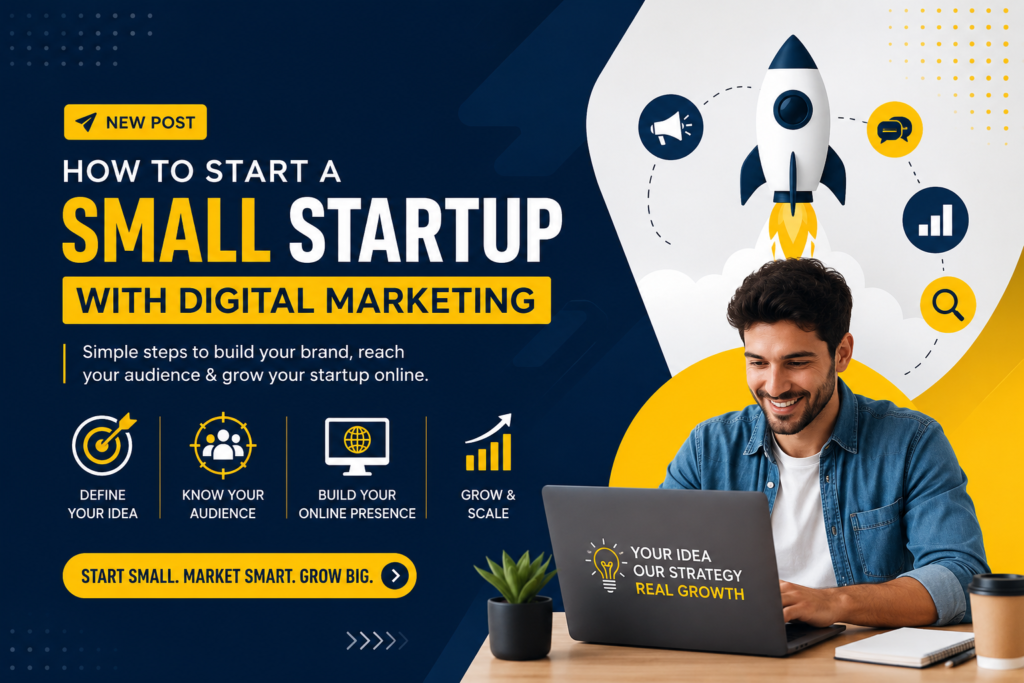
How to Start a Small Startup in Digital Marketing: A Complete Beginner’s Guide
Starting a small startup in digital marketing can be an exciting opportunity for students, freelancers, creators, and aspiring entrepreneurs. Businesses of every size need an online presence, and many of them need professional help to attract customers through search engines, social media, websites, advertising, and content.
The best part is that you do not necessarily need a large office, a big team, or a huge investment to start. With the right skills, a laptop, internet connection, creativity, and a clear strategy, you can start small and gradually build a professional digital marketing business.
However, starting a digital marketing startup is not simply about creating an Instagram page and offering every possible service. You need to understand your target audience, choose the right services, build credibility, create a strong online presence, and develop a system for finding and retaining clients.
This guide explains how to start a small digital marketing startup from the ground up, even if you are a beginner.
What Is a Digital Marketing Startup?
A digital marketing startup is a small business or agency that helps other businesses promote their products and services through digital channels.
Depending on your skills and business model, you can offer services such as:
- Search Engine Optimization (SEO)
- Social Media Marketing
- Content Marketing
- Google Ads and PPC
- Email Marketing
- Website Marketing
- Graphic Design
- Video Marketing
- Online Reputation Management
- Analytics and Reporting
You do not need to offer all these services when you are starting.
In fact, beginning with two or three services can make your business easier to manage and help you become more specialized.
For example, you could start with:
SEO + Content Marketing + Social Media Marketing
and expand your services as your skills and team grow.
1. Learn the Fundamentals of Digital Marketing
Before starting your business, build a strong understanding of digital marketing.
You do not need to become an expert in every area, but you should understand the basic concepts behind the services you plan to sell.
Start learning about:
SEO
SEO helps websites improve their visibility in search engine results. Learn about keywords, search intent, on-page SEO, technical SEO, backlinks, local SEO, and content optimization.
Social Media Marketing
Learn how businesses use social media platforms to build awareness, engage audiences, generate leads, and drive sales.
Content Marketing
Understand how blogs, videos, graphics, guides, and other content can attract and educate potential customers.
Paid Advertising
Learn the basics of Google Ads and social media advertising, including targeting, campaign objectives, budgets, ad creatives, landing pages, and performance measurement.
Analytics
Understand basic marketing metrics such as traffic, engagement, conversions, click-through rate, leads, and return on investment.
Important: Don’t only learn theory. Practice what you learn on your own website or small projects.
2. Choose a Niche
One of the smartest ways to start a small digital marketing startup is to choose a specific niche.
A niche is a particular type of customer or industry you want to serve.
For example:
- Restaurants
- Fashion brands
- Beauty salons
- Real estate businesses
- Local shops
- Startups
- Coaches
- Educational businesses
- Freelancers
- E-commerce stores
Instead of saying:
“We provide digital marketing services for everyone,”
you could say:
“We help small businesses build their online presence through SEO and social media marketing.”
A clear niche can make your marketing message easier to understand.
Why Is a Niche Important?
When you understand one industry deeply, you can create better strategies and content for that audience.
For example, if you specialize in restaurants, you can create marketing packages specifically around:
- Instagram content
- Google Business Profile
- Local SEO
- Food photography
- Customer reviews
- Local advertising
This can make your startup appear more focused and professional.
3. Define Your Services
After choosing your target audience, decide what services you will provide.
Avoid creating a huge list of services that you cannot confidently deliver.
Start with services that match your skills.
For example:
Starter Package
Social Media Marketing
- Content planning
- Social media posts
- Captions
- Hashtag research
- Basic analytics
Growth Package
SEO + Content Marketing
- Keyword research
- On-page SEO
- Blog content
- Website optimization
- Monthly reporting
Complete Package
Digital Marketing
- SEO
- Social media
- Content marketing
- Paid advertising
- Analytics
You can create different packages depending on the needs and budgets of your clients.
4. Create Your Brand Identity
Your brand is how people recognize and remember your business.
Choose a professional:
- Business name
- Logo
- Color palette
- Typography
- Brand voice
- Tagline
- Visual style
Your brand should look consistent across your website, social media profiles, presentations, proposals, and marketing materials.
For example, a modern digital marketing agency might use a clean website with strong typography, professional graphics, subtle animations, and a consistent color scheme.
Do not spend all your money on branding in the beginning. Your priority should be creating a brand that looks professional, trustworthy, and consistent.How to Start a small startup in digital marketing
5. Build a Professional Website
Your website can become the digital home of your startup.
A professional website allows potential clients to learn about your services, view your work, understand your expertise, and contact you.
At minimum, your website should include:
Home Page
Clearly explain:
Who you are + What you do + Who you help
Include a strong headline and a clear call-to-action such as:
“Grow Your Business With Smarter Digital Marketing.”
About Us
Explain your background, mission, values, and approach to digital marketing.
Services
Clearly describe each service and the benefits it provides.
Portfolio
Show examples of your work.
If you do not have clients yet, create practice projects or sample campaigns. Clearly label them as sample or practice work.
Blog
Publish useful articles related to digital marketing and your niche.
Contact
Make it easy for potential clients to contact you.
Include a contact form, email, social media links, or another appropriate communication method.
6. Build a Portfolio Even Without Clients
One of the biggest challenges for beginners is:
“How can I get clients if I don’t have experience?”
The answer is to create your own projects.
You can build sample projects such as:
- A social media campaign
- A sample SEO audit
- A Google Ads campaign concept
- A content calendar
- A website redesign
- A brand identity
- An Instagram carousel
- A blog content strategy
For example, choose a fictional local café and create:
30-day Instagram marketing strategy for a café.
Create sample posts, captions, hashtags, content ideas, and a campaign plan.
Then display the project in your portfolio as a concept project.
This demonstrates your skills without pretending that the project was completed for a real client.
7. Start Building Your Online Presence
If you want businesses to hire you for digital marketing, your own online presence should demonstrate your skills.
Create professional profiles on platforms that are relevant to your audience.
You can share:
- Digital marketing tips
- SEO insights
- Social media strategies
- Case studies
- Design work
- Marketing statistics
- Industry news
- Educational videos
- Blog articles
For example, you could create a weekly series called:
“Digital Marketing Tip of the Week.”
This helps demonstrate your knowledge and can gradually build an audience.
Remember:
Don’t just say you are good at marketing. Show it through your own marketing.
8. Find Your First Clients
Finding your first client can feel difficult, but you have several options.
Network With People
Tell friends, classmates, local business owners, entrepreneurs, and professional contacts about your services.
Contact Local Businesses
Find businesses that have weak or inconsistent online marketing.
For example, you might notice that a local business has:
- An outdated website
- Poor social media activity
- No clear content strategy
- Weak local SEO
- Inconsistent branding
Instead of sending a generic message, identify a specific problem and explain how you could help.
Freelance Platforms
You can also explore legitimate freelance marketplaces to find small projects and build experience.
Create Valuable Outreach
Don’t simply send:
“Hi, I am a digital marketer. Do you need my services?”
Instead, provide something useful.
For example:
“I noticed your business has strong social media potential, but your recent posts aren’t linking visitors back to your website. I have a few ideas that could help improve your online visibility.”
Personalized outreach is usually more meaningful than mass messaging.
9. Create an Effective Client Onboarding Process
Once someone becomes interested in your services, create a professional process.
Start by understanding the client’s business.
Ask about:
- Business goals
- Target audience
- Current marketing
- Competitors
- Budget
- Marketing challenges
- Desired results
Then prepare a clear proposal.
Your proposal can include:
- Client overview
- Current situation
- Marketing problems
- Recommended strategy
- Services
- Timeline
- Deliverables
- Pricing
- Reporting process
- Terms and conditions
A professional process helps create confidence and reduces misunderstandings.
10. Set Your Pricing
Pricing is one of the most important decisions when starting your startup.
There is no single price that works for every business.
Your pricing can depend on:
- Services provided
- Number of platforms
- Amount of content
- Advertising budget
- Client size
- Project complexity
- Your experience
- Expected workload
You can charge:
Project-Based Pricing
Useful for one-time projects such as website audits, branding, or SEO setup.
Monthly Retainer
Useful for ongoing services such as social media management, SEO, or content marketing.
Package Pricing
Create different packages based on client needs.
Avoid competing only on being the cheapest agency. Instead, focus on value, quality, communication, and measurable outcomes.
11. Use Tools to Work Efficiently
Digital marketing involves many tasks, so using the right tools can save time.
Depending on your work, you may need tools for:
- Keyword research
- Website analytics
- Search performance
- Social media scheduling
- Graphic design
- Project management
- Email marketing
- Content creation
- Reporting
You can also use AI tools to assist with brainstorming, research, content planning, and repetitive tasks.
However, AI should support your strategy—not replace human judgment.
Always review AI-generated content for accuracy, originality, brand voice, and usefulness.
12. Track Your Results
A professional digital marketing startup should focus on measurable results.
Different services require different metrics.
For SEO, you might monitor:
- Organic traffic
- Keyword visibility
- Search impressions
- Clicks
- Leads
For social media, you could track:
- Reach
- Engagement
- Followers
- Website clicks
- Leads
For paid advertising:
- Impressions
- Click-through rate
- Cost per click
- Conversions
- Cost per lead
- Return on ad spend
Create regular reports for clients and explain what the numbers mean.
Don’t simply send a spreadsheet full of numbers.
Tell the client:
What happened → Why it happened → What you learned → What you will do next
13. Focus on Client Relationships
Getting a client is only the beginning.
Keeping clients is equally important.
Good communication can make a huge difference.
Keep clients updated about:
- Campaign progress
- Completed work
- Challenges
- Results
- Upcoming tasks
- New opportunities
Be honest about results.
Digital marketing does not guarantee instant success. Some strategies, particularly SEO and content marketing, can require time and consistent effort.
Building trust through honest communication can help create long-term relationships.
14. Grow Your Startup Slowly
Once you have several clients and a consistent workflow, you can start expanding.
You might:
- Hire freelancers
- Build a small team
- Add new services
- Create premium packages
- Develop specialized solutions
- Improve your website
- Invest in better tools
- Build partnerships
Don’t rush to hire a large team.
Start with the smallest structure that allows you to deliver quality work.
For example, you might initially work alone and outsource specialized tasks such as video editing, copywriting, or web development when necessary.
As your client base grows, you can build a dedicated team.
Common Mistakes to Avoid
Starting a digital marketing startup is exciting, but beginners should avoid several common mistakes.
Trying to Serve Everyone
A broad audience can make your marketing message unclear.
Offering Too Many Services
Don’t offer services you cannot deliver professionally.
Copying Competitors
Learn from competitors, but create your own brand and strategy.
Ignoring Your Own Marketing
Your startup’s website and social media are part of your portfolio.
Promising Guaranteed Results
Avoid unrealistic promises such as guaranteed rankings or instant sales.
Not Tracking Results
If you don’t measure your work, you won’t know what is successful.
Giving Up Too Early
Building a business takes time. Focus on learning, improving, and building relationships.
A Simple 30-Day Plan to Start
If you want to begin immediately, use this simple plan.
Week 1: Learn and Plan
- Choose your niche
- Select your main services
- Research competitors
- Define your target audience
- Create your business strategy
Week 2: Build Your Brand
- Choose a business name
- Create your logo
- Define your colors and fonts
- Create social media profiles
- Start building your website
Week 3: Create Your Portfolio
- Create 2–3 sample projects
- Write your service descriptions
- Publish your first blog
- Create social media content
- Prepare a basic proposal
Week 4: Start Marketing
- Contact potential clients
- Network with businesses
- Publish useful content
- Share your portfolio
- Improve your website
- Track your leads and responses
The objective of the first month is not necessarily to become a large agency. The goal is to build a strong foundation and start gaining real-world experience.
Conclusion
Starting a small digital marketing startup does not require a massive investment. What you need most is knowledge, practical skills, consistency, creativity, and a clear strategy.
Start by learning the fundamentals of digital marketing and choosing a specific niche. Decide which services you can confidently provide and create a professional brand around them. Build a website, develop a portfolio using real or clearly labeled practice projects, and demonstrate your expertise through your own online presence.
Then start looking for your first clients through networking, personalized outreach, referrals, and freelance opportunities. Once you have clients, focus on delivering quality work, communicating clearly, tracking results, and building long-term relationships.
As your experience grows, you can expand your services, build a team, and turn your small startup into a professional digital marketing agency.
Most importantly, start small, learn continuously, provide real value, and improve with every project.
The digital world is constantly changing, which means there will always be new opportunities to learn, experiment, and grow.