
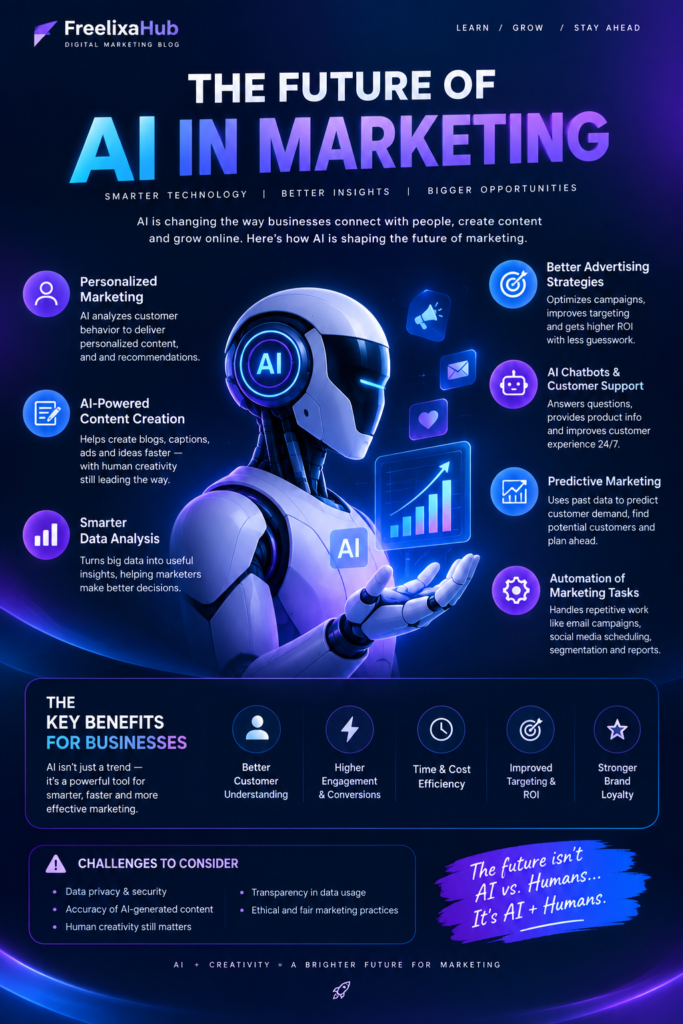
The Future of AI in Marketing: How Artificial Intelligence Is Transforming Digital Marketing
By FreelixaHub | AI & Digital Marketing
Artificial Intelligence (AI) is changing the way businesses connect with customers, promote their products, and grow online. From personalized advertisements to automated customer support, AI is helping marketers work smarter, understand customer needs, and create better marketing strategies.
As technology continues to develop, AI is expected to become an important part of digital marketing. Businesses that learn how to use AI effectively can improve customer experiences, save time, and discover new opportunities for growth.
In this blog, we will explore the future of AI in marketing and how it may transform the digital world.
🤖 What Is AI in Marketing?
AI in marketing refers to the use of artificial intelligence technologies to analyze data, understand customer behavior, automate tasks, and improve marketing activities.
Traditional marketing often depends on manual research and decision-making. AI can help marketers process large amounts of information and identify patterns that may be difficult to notice.
For example, an online shopping website can use AI to recommend products based on a customer’s previous searches, interests, and purchases.
AI does not replace every marketing activity. Instead, it acts as a powerful tool that supports marketers in making better decisions and creating more relevant customer experiences.
🚀 1. Personalized Marketing Experiences
One of the biggest advantages of AI in marketing is personalization.
Customers are more likely to engage with content that matches their interests and needs. AI can analyze customer preferences, browsing behavior, and purchase history to help businesses deliver more relevant messages.
For example, an e-commerce website may recommend clothing based on a customer’s previous purchases. Similarly, a streaming platform may suggest movies based on viewing habits.
How AI helps with personalization:
- Recommending relevant products
- Creating personalized email campaigns
- Showing more relevant advertisements
- Understanding customer preferences
- Improving the overall customer experience
Future possibility: Marketing campaigns may become increasingly personalized, with businesses adapting messages to individual customer needs.
✍️ 2. AI-Powered Content Creation
Content marketing is an important part of digital marketing. Businesses need blog posts, social media captions, videos, advertisements, and website content to attract audiences.
AI tools can help marketers generate ideas, create drafts, summarize information, and adapt content for different platforms.
For example, a digital marketing agency can use AI to develop social media content ideas for a small business or create an initial outline for a blog post.
However, AI-generated content still requires human review. Marketers must focus on originality, accuracy, creativity, and providing genuine value to readers.
Benefits of AI in content marketing:
- Faster content planning
- More creative ideas
- Assistance with writing and editing
- Content personalization
- Easier adaptation for different platforms
Future trend: AI will increasingly support content teams, while human creativity and strategic thinking will remain essential.
📊 3. Smarter Data Analysis
Data is one of the most valuable resources in digital marketing. Businesses collect information from websites, social media, advertising campaigns, and customer interactions.
Analyzing this data manually can take considerable time. AI can help identify patterns, trends, and relationships within large datasets.
Marketers can use these insights to understand:
- Which marketing campaigns perform well
- What customers are interested in
- Which channels generate leads
- How visitors interact with a website
- Where marketing budgets may be better used
For example, AI-powered analytics can help a business identify that its social media advertisements generate more website visits than another advertising channel.
This information can support better marketing decisions.
Why data analysis matters
AI allows marketers to move beyond assumptions and make decisions based on available evidence. However, AI predictions are not always correct, so businesses should combine them with human judgment and reliable data.
🎯 4. The Future of AI in Digital Advertising
Digital advertising is another area where AI is making a major impact.
Businesses use platforms such as Google Ads and social media advertising tools to reach potential customers. AI can help analyze campaign performance, identify audience patterns, and support the optimization of advertising strategies.
For example, AI may help marketers understand which audience segments respond well to a particular advertisement.
AI can support:
- Audience analysis
- Advertisement testing
- Campaign optimization
- Budget planning
- Performance forecasting
- Creative ideas for advertisements
In the future, AI may make advertising campaigns more efficient and responsive.
However, marketers should not depend entirely on automated recommendations. They must continue to monitor advertising performance, protect customer privacy, and ensure that advertisements are fair and accurate.
💬 5. AI Chatbots and Customer Support
Customer communication is an important part of marketing. People often want quick answers about products, prices, services, delivery, and business policies.
AI-powered chatbots can help businesses respond to common questions at any time.
For example, a customer visiting a digital marketing agency website may ask:
“What services does your agency provide?”
An AI chatbot could provide information about SEO, social media marketing, content marketing, and paid advertising.
Benefits of AI chatbots:
- Faster responses to common questions
- Support outside normal business hours
- Improved customer communication
- Assistance with lead generation
- Reduced repetitive work for employees
However, complex issues may still require human support. A combination of AI and human communication can provide a better customer experience.
🔮 6. Predictive Marketing and Customer Behavior
Predictive marketing uses historical data and analytical techniques to estimate possible future outcomes.
AI can help businesses identify patterns in customer behavior and make predictions about future demand, customer interests, and campaign performance.
For example, a clothing brand may analyze previous sales data to estimate which products could become popular during an upcoming season.
How predictive marketing can help:
- Forecasting customer demand
- Identifying potential customers
- Planning seasonal campaigns
- Understanding buying patterns
- Improving marketing decisions
Although predictive AI can be useful, its forecasts are not guaranteed. Changes in customer preferences, economic conditions, and market trends can affect results.
⚡ 7. Automation of Marketing Tasks
Marketing involves many repetitive activities. AI can help automate some of these tasks, allowing marketers to focus more on creativity, strategy, and customer relationships.
Examples of marketing tasks that can be supported by automation include:
- Email scheduling
- Social media planning
- Customer segmentation
- Lead follow-ups
- Marketing reports
- Campaign performance monitoring
For example, an agency may use automation to send a welcome email when someone subscribes to its newsletter.
Automation can save time, but businesses should monitor automated systems carefully to avoid sending irrelevant or inappropriate messages.
🌐 8. AI and Search Engine Optimization
Search engine optimization, or SEO, helps websites improve their visibility in search engines.
AI is changing how marketers approach keyword research, content planning, website analysis, and search behavior.
AI tools can help marketers:
- Discover content ideas
- Analyze search intent
- Identify relevant keywords
- Improve content structure
- Find possible technical SEO issues
- Understand website performance data
In the future, marketers may need to focus even more on creating helpful, original, and trustworthy content.
AI-generated content alone does not guarantee higher search rankings. Websites must provide value to users and follow search engine best practices.
📱 9. AI in Social Media Marketing
Social media platforms generate large amounts of content and user engagement data. AI can help marketers understand what types of content attract attention and how audiences respond.
For example, a business may use AI tools to generate content ideas, analyze engagement patterns, or plan a social media campaign.
AI applications in social media:
- Caption and content ideas
- Audience analysis
- Social media scheduling
- Sentiment analysis
- Creative assistance
- Performance reporting
AI can help businesses manage their social media presence more efficiently. However, authentic communication and human creativity remain important for building strong communities.
🧠 10. AI and Human Creativity: The Future Partnership
Many people wonder whether AI will replace digital marketers.
The more likely outcome is that AI will change the responsibilities of marketers rather than eliminate the need for them.
AI can process data, generate ideas, and automate repetitive tasks. Humans bring creativity, emotional understanding, strategic thinking, and ethical judgment.
For example, AI may suggest several advertising headlines, but a marketer must decide which headline best represents the brand and connects with its audience.
The future of marketing will combine:
- Artificial intelligence
- Human creativity
- Strategic planning
- Customer understanding
- Ethical decision-making
AI can provide the tools, but people provide the vision.
⚠️ Challenges of AI in Marketing
Although AI offers many benefits, businesses must also understand its risks and limitations.
1. Data Privacy
AI systems often use customer data. Businesses must handle personal information responsibly and follow applicable privacy laws.
2. Accuracy Problems
AI can produce incorrect information or misleading content. Human review is important before publishing or using AI-generated material.
3. Lack of Originality
Overdependence on AI may result in repetitive or generic content. Businesses should maintain their unique brand voice.
4. Ethical Concerns
AI should not be used to create misleading advertisements, manipulate customers, or discriminate against certain audiences.
5. Changing Job Responsibilities
As automation increases, marketers may need to develop new skills in AI tools, data analysis, strategy, and creative problem-solving.
🌟 How Businesses Can Prepare for the Future of AI Marketing
Businesses can begin preparing for the future by adopting AI thoughtfully and responsibly.
Practical steps include:
1. Learn about AI tools:
Understand how AI can support content creation, analytics, SEO, and advertising.
2. Start with small tasks:
Use AI for brainstorming, reporting, or repetitive marketing activities.
3. Train your marketing team:
Help employees develop AI-related skills and learn how to evaluate AI-generated results.
4. Protect customer data:
Use responsible data practices and follow relevant privacy requirements.
5. Measure results:
Track whether AI-supported activities actually improve efficiency, engagement, or business performance.
6. Keep humans involved:
Use human judgment for important decisions, creative direction, and customer relationships.
📈 Benefits of AI in the Future of Marketing
AI may offer several important advantages to businesses:
| Benefit | How AI Can Help |
|---|---|
| Better personalization | Deliver more relevant content and recommendations |
| Improved efficiency | Automate repetitive marketing activities |
| Smarter decisions | Analyze data and identify useful patterns |
| Better customer support | Respond to common questions quickly |
| Campaign optimization | Support advertising and content improvements |
| Business growth | Help marketers identify opportunities |
The actual results will depend on the quality of the data, the tools being used, and how effectively businesses implement AI.
🔥 Conclusion: The Future of AI in Marketing
The future of AI in marketing is full of exciting opportunities. Artificial intelligence is helping businesses understand customers, create content, analyze data, automate tasks, and improve digital advertising strategies.
From personalized marketing experiences to AI-powered chatbots and predictive analytics, AI is becoming an important part of the digital marketing industry.
However, successful marketing will not depend on technology alone. Human creativity, strategic thinking, ethical practices, and genuine customer relationships will remain essential.
The future belongs to businesses that combine the power of AI with human intelligence.
As AI continues to develop, digital marketers who learn how to use it responsibly and effectively will be better prepared for the changing digital landscape.