
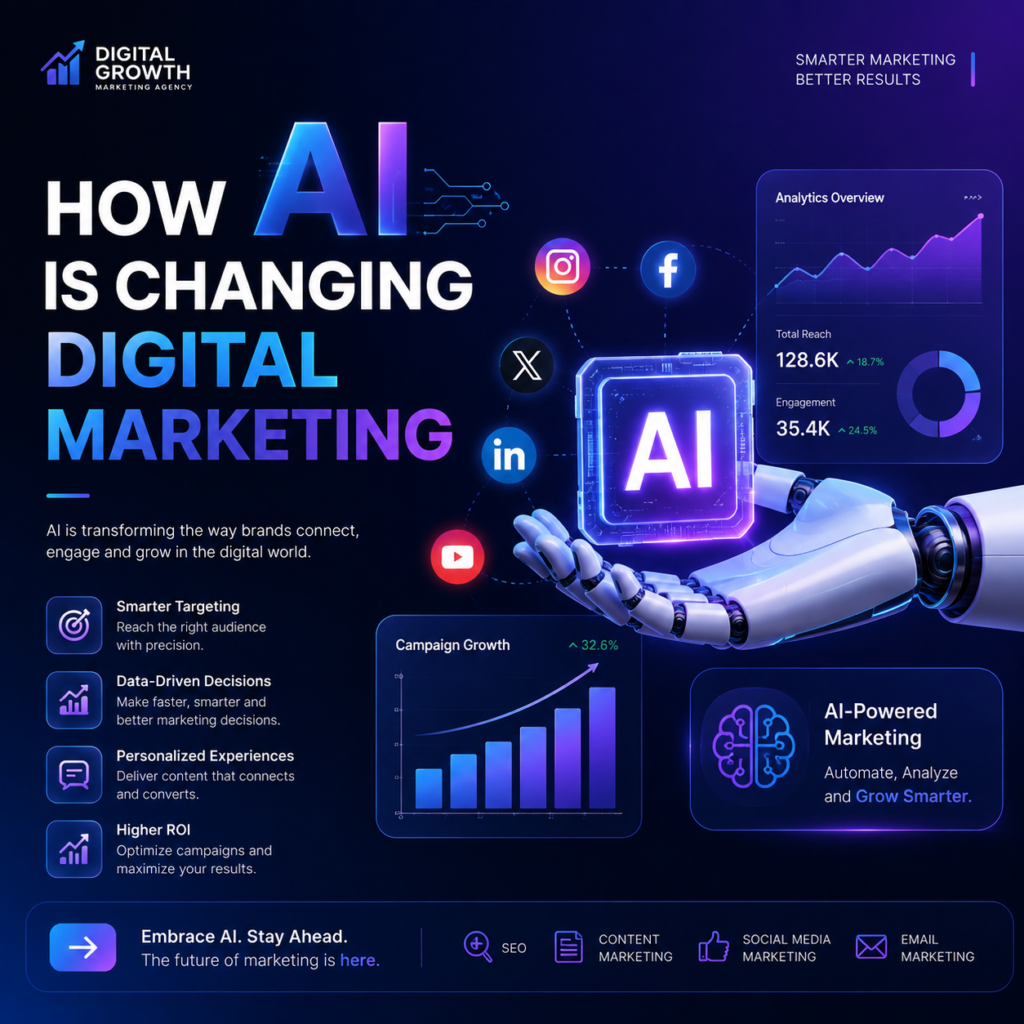
How AI Is Changing Digital Marketing: The Future
Introduction
Artificial Intelligence (AI) is transforming the way businesses connect with customers, create content, and promote their products and services online. From personalized advertisements to automated customer support, AI is helping marketers work smarter, save time, and make better decisions.
In the past, digital marketing mainly depended on manual research, content creation, and traditional advertising methods. Today, AI-powered tools can analyze large amounts of data, identify customer preferences, generate content ideas, and support marketing campaigns.
As businesses compete for attention in the digital world, understanding AI has become increasingly important for marketers, entrepreneurs, and digital marketing students.
In this blog, we will explore how AI is changing digital marketing, its major benefits, practical applications, challenges, and the future of AI-powered marketing.
What Is Artificial Intelligence in Digital Marketing?
Artificial Intelligence refers to technology that enables computers and software to perform tasks that normally require human intelligence, such as learning from data, recognizing patterns, understanding language, and making predictions.
In digital marketing, AI helps businesses understand their customers and improve marketing activities through automation, data analysis, and intelligent software.
For example, AI can help a digital marketer:
- Generate blog topic ideas.
- Analyze customer behavior.
- Personalize marketing messages.
- Improve advertising campaigns.
- Predict potential customer interests.
- Automate repetitive marketing tasks.
- Create content drafts and marketing visuals.
AI does not replace every responsibility of a marketer. Instead, it acts as a powerful assistant that can support creativity, research, and decision-making.
10 Ways AI Is Changing Digital Marketing
1. AI Is Revolutionizing Content Creation
Content marketing is one of the most important parts of digital marketing. Businesses regularly need blog posts, social media captions, advertisements, email campaigns, and website content.
Creating all this content manually can take a significant amount of time. AI tools can help marketers speed up the content creation process.
How AI helps with content creation
- Generates blog topic ideas.
- Creates content outlines.
- Helps draft articles.
- Suggests headlines.
- Writes social media captions.
- Supports email marketing drafts.
- Helps develop video scripts.
- Suggests content calendars.
For example, a digital marketing agency can use AI to generate ideas for a blog titled “5 SEO Strategies for Small Businesses.” A marketer can then research the topic, verify the information, and create a useful, original article.
Benefits
- Saves time.
- Supports brainstorming.
- Improves workflow efficiency.
- Helps maintain a regular publishing schedule.
Important consideration
AI-generated content should be reviewed by humans to ensure accuracy, originality, helpfulness, and alignment with the brand’s voice.
2. AI Is Improving Search Engine Optimization
Search Engine Optimization, or SEO, helps websites appear in relevant search engine results.
AI is changing how marketers approach keyword research, content planning, search behavior analysis, and website optimization.
How AI supports SEO
Keyword Research:
AI tools can help identify related search terms and potential content topics.
Content Planning:
AI can suggest questions users may want answered and help organize content into useful sections.
Content Optimization:
AI can help review headings, readability, internal linking opportunities, and topic coverage.
Technical Analysis:
Some AI-powered SEO platforms can assist with identifying website issues and prioritizing optimization tasks.
Search Intent Analysis:
AI can help marketers understand whether users are looking for information, products, services, or solutions.
Example
Suppose a digital marketing blog wants to rank for the keyword “digital marketing tips for beginners.”
AI can help suggest related topics such as:
- SEO basics.
- Social media marketing.
- Email marketing.
- Content marketing.
- Google Analytics.
- Website optimization.
The marketer still needs to create genuinely useful content and follow search engine guidelines.
Remember: AI can support SEO, but it cannot guarantee higher Google rankings.
3. AI Is Personalizing Customer Experiences
Personalization means delivering content, recommendations, or messages that are relevant to a user’s interests or needs.
AI can analyze customer interactions and help businesses provide more relevant experiences.
For example, an online shopping website may recommend products based on a customer’s browsing behavior, previous purchases, or stated preferences.
Examples of AI personalization
- Personalized product recommendations.
- Customized email campaigns.
- Relevant content suggestions.
- Audience segmentation.
- Personalized website experiences.
- Targeted marketing messages.
Example
Imagine a customer visits a website several times to read articles about SEO.
An AI-powered system may help the business recommend more SEO-related content or offer a relevant beginner’s guide.
This can make the website experience more useful and engaging.
Benefits
- Better customer engagement.
- More relevant content.
- Improved user experience.
- Potentially higher conversion rates.
Privacy matters: Personalization should respect user consent, applicable privacy laws, and reasonable expectations about how data is used.
4. AI Is Transforming Social Media Marketing
Social media marketing requires regular content creation, audience engagement, trend analysis, and performance tracking.
AI tools can help marketers manage many of these activities more efficiently.
How AI helps social media marketers
- Suggests post ideas.
- Creates caption drafts.
- Helps plan content calendars.
- Assists with social media visuals.
- Analyzes engagement patterns.
- Supports comment and message management.
- Helps identify content trends.
- Assists with audience research.
Example
A digital marketing agency wants to promote its services on Instagram.
AI can help generate ideas for:
- SEO tips.
- Marketing carousel posts.
- Short video scripts.
- Digital marketing myths.
- Website traffic tips.
- Social media growth strategies.
The marketer can then edit the content, add original insights, and ensure that it matches the agency’s branding.
Why this is useful
AI can reduce repetitive work and help marketers spend more time on strategy, creativity, and audience relationships.
However, automatically publishing large amounts of low-quality content can damage audience trust.
5. AI Is Making Advertising More Effective
Online advertising is an important part of digital marketing. Businesses use platforms such as Google Ads and Meta Ads to reach potential customers.
AI-powered advertising systems can help analyze campaign data and optimize certain aspects of ad delivery.
How AI supports advertising
- Helps identify audience segments.
- Assists with advertisement creation.
- Analyzes campaign performance.
- Supports budget optimization.
- Helps test different messages.
- Identifies patterns in conversions.
- Assists with predicting campaign outcomes.
Example
Suppose a digital marketing agency runs an advertising campaign for a website design service.
AI-powered advertising tools may help identify which audience groups are more likely to interact with the advertisements or complete a desired action.
The marketer can use this information to improve the campaign.
Benefits
- Better use of advertising data.
- Faster campaign analysis.
- More efficient optimization.
- Support for campaign testing.
Important point
AI does not guarantee profitable advertising. Marketers still need clear goals, suitable landing pages, accurate tracking, and budget control.
6. AI Is Improving Customer Support Through Chatbots
AI-powered chatbots are changing how businesses communicate with website visitors.
A chatbot can answer frequently asked questions, provide basic information, and guide visitors toward useful resources.
Common chatbot applications
- Answering service-related questions.
- Explaining product features.
- Helping users find blog articles.
- Collecting contact information with permission.
- Providing basic customer support.
- Guiding visitors through a website.
Example
A digital marketing agency website may have a chatbot that answers questions such as:
Visitor: What services does your agency provide?
AI Chatbot: We provide SEO, social media marketing, content marketing, website marketing, and online advertising services.
Visitor: How can I contact your agency?
AI Chatbot: You can contact our team through the contact form or email provided on our website.
Benefits
- Faster responses.
- Support outside regular working hours.
- Reduced repetitive inquiries.
- Better website navigation.
Limitations
Chatbots may sometimes provide incorrect or incomplete information. Businesses should offer a way for users to contact a human representative when necessary.
7. AI Is Helping Marketers Understand Customer Behavior
Understanding customer behavior is essential for creating successful marketing campaigns.
AI can analyze large amounts of information and identify patterns that may be difficult to detect manually.
Data AI can help analyze
- Website visits.
- Page engagement.
- Search behavior.
- Customer interactions.
- Purchase history, where appropriately collected.
- Email engagement.
- Advertising performance.
- Customer feedback.
Example
A digital marketing blog notices that visitors spend more time reading articles about social media marketing than general marketing topics.
AI-assisted analytics may help identify this pattern. The marketing team can then create more useful content related to social media strategies.
Benefits
- Better audience understanding.
- Improved content planning.
- More informed marketing decisions.
- Identification of possible customer trends.
Important: AI-generated insights should be checked against reliable data. A pattern does not always prove why customers behave in a certain way.
8. AI Is Automating Repetitive Marketing Tasks
Digital marketers often spend a lot of time performing repetitive activities.
AI and marketing automation tools can help simplify some of these tasks.
Examples of marketing automation
- Scheduling social media posts.
- Organizing marketing data.
- Drafting email messages.
- Generating campaign reports.
- Categorizing customer inquiries.
- Creating content briefs.
- Summarizing performance information.
- Assisting with lead management.
Example
A marketer may spend hours preparing a weekly performance report.
An AI tool can help summarize website traffic, advertising results, and social media engagement. The marketer can then review the data and create a final report.
Benefits
- Saves time.
- Reduces repetitive work.
- Improves workflow organization.
- Allows marketers to focus on strategic activities.
Automation should always be monitored to prevent errors and ensure that customers receive accurate information.
9. AI Is Supporting Email Marketing
Email marketing is an effective way to build relationships with subscribers and share valuable information.
AI can help marketers create more relevant email campaigns and improve their workflow.
How AI helps email marketing
- Suggests email subject lines.
- Creates newsletter drafts.
- Helps segment audiences.
- Recommends content ideas.
- Supports email personalization.
- Analyzes engagement data.
- Assists with campaign testing.
Example
A digital marketing blog can send different newsletters to different groups of subscribers.
One group may be interested in SEO, while another may prefer social media marketing.
AI can help organize these audiences and suggest relevant content for each group.
Benefits
- More relevant communication.
- Improved campaign planning.
- Better use of subscriber data.
- Time savings.
However, businesses should obtain appropriate consent, follow email marketing laws, and provide a clear unsubscribe option.
10. AI Is Changing Marketing Analytics and Reporting
Marketing analytics helps businesses understand whether their strategies are achieving their goals.
AI-powered analytics tools can assist marketers in reviewing data and identifying possible patterns.
How AI supports marketing analytics
- Summarizes campaign performance.
- Identifies changes in website traffic.
- Highlights unusual data patterns.
- Helps compare marketing channels.
- Supports forecasting.
- Assists with reporting.
- Suggests areas for further investigation.
Example
A digital marketing agency may use AI-assisted reporting to compare the performance of SEO, social media, and paid advertising campaigns.
The report may help the team understand which channels are attracting visitors and which are contributing to leads or sales.
Benefits
- Faster reporting.
- Easier data interpretation.
- Better campaign monitoring.
- Support for data-driven decisions.
Remember: AI predictions are estimates, not guarantees. Marketers should consider business conditions, data quality, and external factors before making decisions.
Benefits of AI in Digital Marketing
AI offers several important benefits to businesses and marketing professionals.
1. Saves Time
AI can assist with repetitive tasks and content planning, allowing marketers to focus on more important activities.
2. Improves Efficiency
Marketing teams can use AI tools to organize workflows and complete certain tasks faster.
3. Supports Personalization
AI can help businesses deliver more relevant content and recommendations.
4. Helps Analyze Data
AI can process large datasets and identify patterns that support marketing decisions.
5. Improves Customer Experience
Chatbots and personalized content can make online interactions more convenient.
6. Supports Creativity
AI can help marketers brainstorm ideas, explore concepts, and develop content drafts.
7. Helps Small Businesses
Small businesses can use affordable AI tools to support content creation, marketing planning, and customer communication.
Challenges of Using AI in Digital Marketing
Although AI provides many advantages, it also creates challenges that marketers must understand.
1. Content Accuracy
AI tools can generate incorrect or misleading information. Human review is essential, especially for technical, financial, legal, or health-related content.
2. Privacy Concerns
AI systems may process customer data. Businesses must handle personal information responsibly and follow applicable privacy regulations.
3. Lack of Originality
Publishing too much generic AI-generated content can make a brand appear unoriginal.
4. Overdependence on Technology
Marketers should not rely entirely on AI. Human creativity, judgment, empathy, and strategic thinking remain important.
5. Security Risks
Poorly managed AI systems can create risks involving data protection, unauthorized access, or misleading automated communications.
6. Changing Skills
Digital marketers need to develop new skills, including AI literacy, data analysis, prompt writing, content editing, and ethical technology use.
7. Advertising Bias
AI systems may produce biased results or make inaccurate assumptions about audiences. Campaigns should be monitored carefully.
How Digital Marketers Can Use AI Effectively
To gain the most value from AI, marketers should use it thoughtfully and strategically.
Step 1: Define Your Goal
Decide what you want AI to help you achieve.
For example:
- Create blog ideas.
- Improve content planning.
- Analyze marketing data.
- Support customer service.
- Develop advertising concepts.
Step 2: Choose the Right AI Tool
Select tools according to your needs, budget, data requirements, and workflow.
Step 3: Provide Clear Instructions
Give AI specific information about your audience, brand tone, topic, and desired outcome.
Step 4: Review the Results
Check AI-generated content for accuracy, originality, clarity, and relevance.
Step 5: Add Human Creativity
Include your own ideas, experience, examples, and insights.
Step 6: Measure Performance
Track whether AI-assisted activities are actually improving your marketing results.
Step 7: Protect Customer Data
Avoid sharing sensitive or unnecessary personal information with AI tools.
Future of AI in Digital Marketing
The future of digital marketing will likely involve greater cooperation between human marketers and AI-powered technologies.
AI may continue to influence:
- Personalized customer experiences.
- Automated marketing workflows.
- Search and content discovery.
- Advertising optimization.
- Predictive analytics.
- Voice and conversational marketing.
- Customer support.
- Marketing performance measurement.
Businesses that learn how to use AI responsibly may gain advantages in efficiency, creativity, and customer engagement.
However, successful marketing will still depend on understanding people, solving customer problems, building trust, and providing real value.
AI can process information and assist with decisions, but human marketers remain responsible for strategy, ethics, and the quality of customer experiences.
AI Tools Digital Marketers Can Explore
Here are some categories of AI tools that marketers may find useful:
| AI Tool Category | Common Uses |
|---|---|
| AI Writing Assistants | Blog drafts, content ideas, captions |
| AI Design Tools | Graphics, presentations, creative concepts |
| AI SEO Tools | Keyword research, content planning, optimization |
| AI Chatbots | Customer support and website assistance |
| AI Analytics Tools | Data analysis and performance reporting |
| AI Email Marketing Tools | Personalization and campaign assistance |
| AI Video Tools | Video scripts, editing, and creative production |
Tip: Before choosing a tool, check its features, pricing, privacy policy, and whether it fits your marketing requirements.
Conclusion
Artificial Intelligence is changing digital marketing by helping businesses create content, understand customers, automate repetitive tasks, improve advertising, and analyze marketing performance.
From SEO and social media marketing to email campaigns and customer support, AI is becoming an important part of modern marketing strategies.
However, AI is not a complete replacement for human marketers. The best results come from combining AI technology with creativity, research, strategic thinking, and ethical decision-making.
For digital marketing students, freelancers, and business owners, learning how to use AI effectively can be a valuable step toward building a successful career or business in the digital world.
The future of digital marketing is not just about using AI. It is about using AI intelligently to create better experiences, stronger strategies, and meaningful results.
Frequently Asked Questions
1. How is AI changing digital marketing?
AI is helping marketers automate tasks, create content, analyze data, personalize customer experiences, and improve marketing campaigns.
2. Can AI replace digital marketers?
AI can automate certain tasks, but it cannot completely replace human creativity, strategic thinking, communication, and judgment.
3. How can beginners use AI in digital marketing?
Beginners can use AI for content ideas, blog outlines, social media captions, keyword research assistance, and marketing planning.
4. Is AI-generated content good for SEO?
AI-generated content can be useful when it is accurate, original, helpful, and created to serve users. Automatically generated low-quality content may harm a website’s reputation and search performance.
5. What are the biggest benefits of AI in marketing?
The major benefits include improved efficiency, faster content production, data analysis, personalization, and support for marketing automation.